
The army confirmed that they will buy 12 Nishant Unmanned Aerial Vehicle for reconnaissance and surveillance operations, a top Defence Research and Development Organisation official said on Friday.

The five-day event will include aerial displays by aircraft and helicopters along with a large exhibition and trade fair of aerospace and defence companies.
The missile was aimed at a moving object, sources said.
The indigenous Kaveri aircraft engine, soon to make its debut flight, lacks the muscle needed by India's Tejas light combat aircraft, which the engine was designed to power. In its present form, the Kaveri will never power a modern fighter. The Indian Navy is snapping up the Kaveri for powering its growing fleet of warships.
Tactical systems such as main battle tank Arjun, light combat aircraft Tejas, a family of radars, electronic warfare systems, sonars, torpedoes, armaments and missiles have been successfully developed in the country and many of them are being delivered to the armed forces. The recent success of the DRDO (Defence Research and Development Organisation) in the launch of interceptor missile and Agni-III has taken our country into the elite club of a few developed nations.
Defence Minister A K Antony on Tuesday indicated a revamp of the Defence Research and Development Organisation, to give it capability to produce futuristic systems within the country."DRDO will have to play a crucial role in providing strategic defence with suitable delivery systems to the nation," Antony said. The DRDO and the end-users, the armed forces, would have to work with greater synergy to achieve the goal of self-reliance and minimise dependence on foreign nations.
India on Sunday test-fired the 290-km range BrahMos cruise missile from the Integrated Test Range at Chandipur off the Orissa coast. "It was a user's trial by the defence forces," said a Defence Research and Development Organisation official. "User's trial of BrahMos conducted by the Indian Army was successful," ITR Director S P Dash said after the missile blasted off from a mobile launcher at nearly 11.35 am from the launch complex-3 of the test range.
India will test fire its long-range surface-to-surface missile, Agni-III, by the year end and has started induction of the Agni-I and Agni-II versions in a newly raised strategic command, Dr M Natrajan, scientist claimed on Tuesday.
The Indian government has never bothered to formulate a coherent national policy on cyber war, reports Vicky Nanjappa

The Defence Research and Development Organisation (DRDO) in Leh has conducted research on the double hump or Bactrian camels which can carry load of 170 kilogrammes at an elevation of 17,000 feet height in the Eastern Ladakh region.

The indigenous howitzer gun that was used for the ceremonial salute on Monday has been designed by the Centre-run Defence Research and Development Organisation (DRDO).
Scientists at the Leh-based Regional Research Laboratory have cross-bred the region's famous yaks with high yielding Swiss cows to produce a new breed, which can withstand extremely high altitudes.
Moving a step closer to completing its nuclear triad, India today successfully test fired a ballistic missile, with a strike range of around 1,500 km, from an underwater platform in Bay of Bengal. "The medium range K-5 ballistic missile was test fired successfully today from an underwater pontoon and all parameters of the test firing were met," said Defence Research and Development Organisation chief V K Saraswat from the undisclosed test area.

Access to India's defence market must be made conditional -- available only to those who are ready to make a long-term commitment in India, argues Ajai Shukla.
After failing to hit its target in the previous test, a new version of the 290 km-range supersonic BrahMos cruise missile was on Wednesday successfully test launched at a firing range in Pokhran in Rajasthan.

India on Friday successfully test-fired indigenously-developed anti-tank guided missile systems, 'Helina' and 'Dhruvastra', paving their induction into the Army and the Indian Air Force respectively, officials said.
The grenade will help them to smoke out terrorists from their hiding without any bloodshed and save hostages. The 'chilli smoke grenade' will irritate eyes, skin and respiratory traits, inflicting an immediate breathing difficulty and swelling of eyes to force the persons to come out in the open.

SAAW, an indigenously designed and developed 120 kg class smart weapon, has been developed by the Defence Research and Development Organisation.
This is the first of a four-part series on the DRDO, which has instituted fundamental changes in the way it will approach equipment development.
K Santhanam, former Defence Research and Development Organisation scientist, who has rubbished the nuclear test at Pokhran in 1998 told journalists that he believed India neede to conduct two more tests to perfect the thermo-nuclear technology required to make a Hydrogen bomb. Santhanam maintained that simulations or computer-based tests were not enough to perfect thermo-nuclear technology. His statements are an antithesis of the Indian governments' position on this issue.
As protests rage in Kudankulam and reach a crescendo, V Ponraj, scientific advisor to Dr A P J Abdul Kalam, speaks about the report he and the former Indian President prepared in this interview with rediff.com's Shobha Warrier.
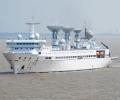
The southern deep-sea port of Hambantota is considered strategically important for its location.
The indigenously built multi-target missile can carry a 50kg payload.
This will be the second launch of the 3,000-km range missile after an unsuccessful test on July nine last year from the integrated test range at Wheeler Island near Balasore in Orissa, defence officials said.
The DRDO has clearly decided that developing technologies is at least as important as developing weapons systems. V K Aatre, DRDO chief from 2000-04, had said, "Weapons programmes and technologies have to maintain equal pace." Only now is the DRDO heeding his advice.
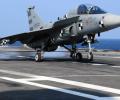
The naval version of Tejas light combat aircraft is in development stage. Officials said the successful "arrested landing" of the prototype of the naval version of Tejas on the deck of INS Vikramaditya is expected to speed up development of the jet for the Indian Navy.
India is deploying cutting-edge technology to defeat a simple insurgent weapon that J&K militants and Naxals are using to lethal effect: the Improvised Explosive Device, or IED. Swedish company Saab has offered to partner India's Defence Research and Development Organisation in fitting Saab's CARABAS radar on India's Dhruv Advanced Light Helicopter (ALH), which would allow the scanning of wide swathes of territory to detect IEDs well before they can be exploded.
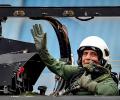
Wearing a G suit, the minister buckled himself in the seat behind the pilot in the aircraft.

India on Monday successfully test-fired its nuclear-capable Agni-II missile intermediate range ballistic missile, with a range of 2000 kms, from the Wheelers Island off Orissa coast.
After failing to hit the target in the previous test, the Defence Research and Development Organisation is planning to test-fire the Block II version of the BrahMos supersonic cruise missile on March 4."We are planning to conduct the second test of the BrahMos Block II version at the Army's test range in Pokharan on March 4 this week," Defence Ministry officials said.

The BrahMos export order would be the biggest for the country in this field and is likely to propel India amongst arms exporting countries as more orders for the missile are expected from other friendly countries.
India's indigenous Light Combat Aircraft Tejas has successfully completed air-to-air close combat missile firing tests, ahead of its clearance for induction into the Indian Air Force.
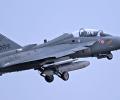
Air Chief Marshal B S Dhanoa calling the FOC a 'major milestone'.
In the midst of the controversy over the success of the 1998 thermonuclear test, nuclear scientist P K Iyengar has said the views of former Defence Research and Development Organisation scientist K Santhanam on the issue are the 'clincher'. There is a "strong reason to believe that the thermonuclear device had not fully burnt and, therefore, further testing was called for," Iyengar, a former Atomic Energy Commission chairman, said.
After three successful ballistic missile tests during the last fortnight, the Defence Research and Development Organisation is finalising preparations for the big one.
